
Struggling to decide what to post on social media every day? You’re not alone.
For many businesses, social media marketing sounds simple: create a post, publish it, and wait for customers. But consistently coming up with fresh, useful, and engaging content can be one of the biggest challenges.
The good news is that you don’t need to create complicated content every day. A strong social media strategy combines educational posts, promotional content, customer stories, behind-the-scenes content, videos, questions, and industry insights.
In this guide, you’ll discover 30 practical social media content ideas for businesses that can help increase engagement, build trust, showcase your expertise, and generate leads.
Why Is Social Media Content Important for Businesses?
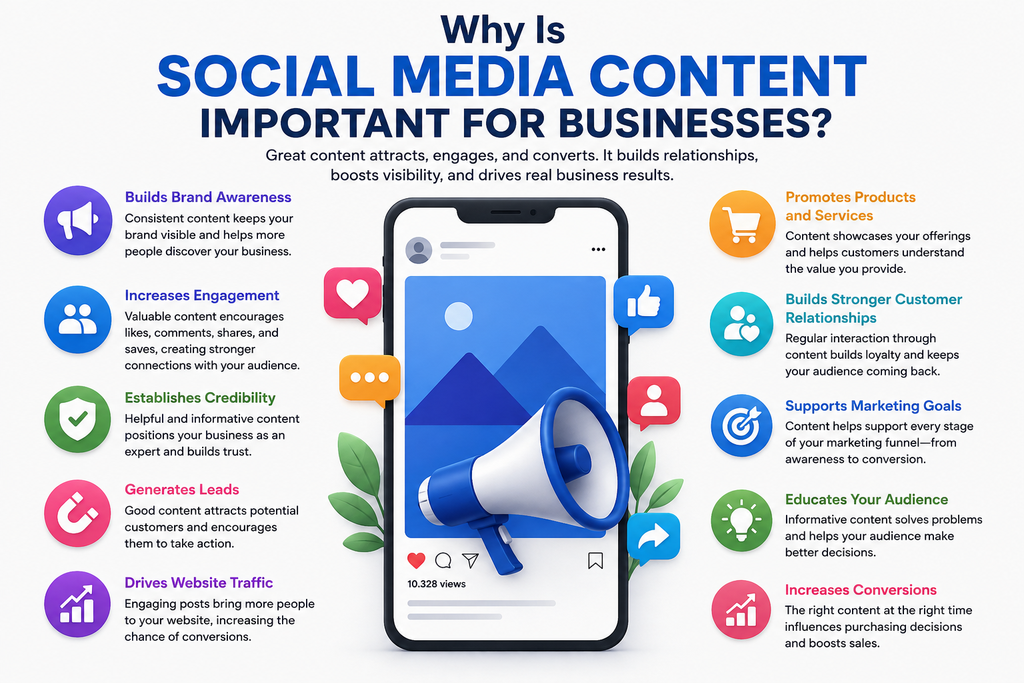
Social media gives businesses an opportunity to communicate directly with their target audience.
A consistent content strategy can help you:
- Build brand awareness
- Increase audience engagement
- Establish credibility
- Generate leads
- Promote products and services
- Educate potential customers
- Build stronger customer relationships
- Drive website traffic
- Increase conversions
- Create a recognizable brand identity
However, successful social media marketing isn’t about posting as much as possible. It’s about posting content that provides value and gives people a reason to follow, engage with, and remember your brand.
30 Social Media Content Ideas for Businesses
1. Share Educational Tips
Create simple posts that teach your audience something useful related to your industry.
For example:
“5 Ways to Improve Your Instagram Engagement”
Educational content positions your business as a helpful source of information rather than simply another company trying to sell something.
Best formats: Carousel, infographic, short video, Reel.
2. Behind-the-Scenes Content
Show people what happens behind your business.
You could share:
- How products are made
- Your workspace
- Team activities
- Packaging orders
- Preparing for an event
- A typical day at your company
Behind-the-scenes content makes your brand feel more human and authentic.
3. Introduce Your Team
People connect with people—not just logos.
Introduce employees and team members by sharing their:
- Name
- Role
- Experience
- Responsibilities
- Interesting facts
This is an easy way to humanize your brand.
4. Customer Testimonials
Show potential customers what existing customers think about your business.
Share genuine testimonials as:
- Image posts
- Videos
- Carousels
- Stories
- Short-form videos
Customer testimonials can provide valuable social proof when someone is considering your product or service.
5. Product Demonstration
Don’t just tell people what your product does. Show them.
Create a short video demonstrating:
- How it works
- How to use it
- Its key features
- Common use cases
- Before-and-after results
Demonstration content can make complex products easier to understand.
6. Frequently Asked Questions
Your customers probably ask similar questions repeatedly.
Turn those questions into social media content.
For example:
Question: How long does delivery take?
Answer: We usually deliver within 3–5 business days.
You can create an entire content series around customer FAQs.
7. Share Industry Statistics
People love interesting data.
Share relevant statistics about your industry and explain what they mean for your audience.
For example:
“Did you know that short-form video continues to be one of the most important content formats for social media marketers?”
Always verify statistics before publishing them.
8. Create a “How-To” Post
Show your audience how to accomplish something.
Examples:
- How to choose the right laptop
- How to create a social media strategy
- How to save money on marketing
- How to improve website conversions
- How to use your product
How-to content is particularly useful because it provides immediate value.
9. Share Customer Success Stories
Tell the story of how your product or service helped a customer.
A simple structure is:
Problem → Solution → Result
For example:
“A local business was struggling to generate leads. After implementing a targeted social media strategy, it started receiving qualified enquiries consistently.”
This type of content combines storytelling with proof.
10. Create Polls
Ask your audience to choose between two or more options.
Examples:
Which platform do you use most?
Or:
Which content do you prefer?
- Reels
- Carousels
Polls are simple but effective for increasing interaction and learning about your audience.
11. Share Industry News
Keep your followers informed about important developments in your industry.
You can explain:
- New trends
- New technologies
- Platform updates
- Consumer behavior changes
- Industry developments
Don’t simply share the news—add your own expert opinion.
12. Before-and-After Posts
If your business produces measurable transformations, showcase them visually.
Examples include:
- Website redesigns
- Interior design projects
- Fitness transformations
- Branding projects
- Marketing results
- Product improvements
Before-and-after content is naturally visual and easy to understand.
13. Share a Quick Tip
Not every post needs to be long.
Create short, useful tips such as:
Marketing Tip: Don’t create content for everyone. Create content specifically for your ideal customer.
These posts are easy to consume and can become part of a recurring content series.
14. Create Short-Form Videos
Short-form video is an important format for businesses wanting to reach audiences on platforms such as Instagram, YouTube, Facebook, and TikTok.
You can create videos about:
- Tips
- Tutorials
- Product features
- FAQs
- Industry insights
- Customer stories
- Behind-the-scenes moments
Keep the opening strong enough to make viewers want to continue watching.
15. Share a Business Milestone
Celebrate important achievements with your audience.
Examples:
- Reaching 1,000 customers
- Business anniversary
- Launching a new service
- Opening a new location
- Winning an award
- Reaching a social media milestone
Milestone posts make followers feel like they’re part of your business journey.
16. Share a Customer Question
Turn a real customer question into educational content.
For example:
“A customer recently asked us: Which digital marketing strategy is best for a small business?”
Then provide a useful answer.
This makes your content directly relevant to real customer needs.
17. Create a Myth vs. Fact Post
Choose a common misconception in your industry and correct it.
Example:
MYTH: You need thousands of followers to generate sales.
FACT: A smaller audience of highly relevant potential customers can be more valuable than a large, unrelated audience.
This format is excellent for creating curiosity.
18. Share Business Tips
Share practical advice that your target customers can apply.
For example, a digital marketing agency could publish:
5 Marketing Mistakes Small Businesses Should Avoid
A financial company could share:
5 Simple Ways to Manage Business Expenses
Make the tips specific rather than generic.
19. Run a Contest or Giveaway
Give your audience a reason to participate.
For example:
“Comment below with your favorite product and one winner will receive a special discount.”
Make sure your contest follows the rules and policies of the platform you’re using and any applicable local laws.
20. Share User-Generated Content
If customers post about your product or service, consider sharing their content—with appropriate permission.
User-generated content can:
- Build trust
- Encourage community participation
- Provide authentic social proof
- Give you additional content
Create a branded hashtag if it makes sense for your business.
21. Share a Motivational Quote
Motivational content can work well when it fits your brand and audience.
Instead of posting random quotes, connect the message to your business or industry.
For example:
“Consistency beats perfection.”
Then add a short caption explaining how the idea applies to your audience.
22. Ask Your Audience a Question
Turn your social media page into a conversation.
Examples:
- What’s your biggest marketing challenge?
- Which product should we launch next?
- What topic would you like us to explain?
- What is one thing you wish you knew before starting your business?
Questions can generate useful comments and customer insights.
23. Share Your Process
Explain how your business works.
For example:
How We Create a Social Media Campaign
- Audience research
- Content planning
- Creative development
- Publishing
- Performance tracking
- Optimization
Process-based content demonstrates expertise and transparency.
24. Create a Comparison Post
Help customers make better decisions.
Examples:
- Product A vs. Product B
- Organic vs. Paid Marketing
- Instagram vs. LinkedIn
- Website vs. Social Media
- Freelancer vs. Agency
The goal isn’t necessarily to say one option is always better. Explain which option is better for which situation.
25. Share a Free Resource
Give your audience something useful.
Examples:
- Checklist
- Template
- E-book
- Guide
- Calculator
- Content calendar
- Free consultation
Free resources can also become effective lead-generation tools.
26. Show Your Product in Real Life
Instead of using only professional product photos, show your product being used in a real-world situation.
For example:
Instead of: A photo of a coffee machine.
Try: A short video showing someone making coffee before starting their workday.
Real-life context helps customers visualize how your product fits into their lives.
27. Share Common Mistakes
Create content around mistakes your customers should avoid.
For example:
7 Social Media Mistakes Small Businesses Should Avoid
This type of content works because people are naturally interested in learning what they might be doing wrong.
28. Create a Weekly Content Series
Don’t rely entirely on random posts.
Create recurring content such as:
- Monday Marketing Tip
- Tuesday Tool Recommendation
- Wednesday FAQ
- Thursday Industry Insight
- Friday Customer Story
A recurring series makes content planning easier and creates consistency.
29. Repurpose Existing Content
You don’t always need to create something completely new.
Turn one blog post into:
1 Blog → 1 LinkedIn post → 1 Instagram carousel → 3 Reels → 5 Stories → 1 email
Repurposing allows you to get more value from content you’ve already created.
30. Share a Strong Call-to-Action
Sometimes the best content idea is simply asking your audience to take the next step.
Examples:
- “Visit our website to learn more.”
- “Send us a DM for details.”
- “Download the free guide.”
- “Book a consultation.”
- “Comment your question below.”
- “Save this post for later.”
Every promotional post doesn’t need to sell immediately. The CTA should match the goal of the content.
Bonus: 30 Ideas at a Glance
| # | Content Idea | Main Goal |
|---|---|---|
| 1 | Educational Tips | Educate |
| 2 | Behind the Scenes | Humanize |
| 3 | Team Introduction | Build Trust |
| 4 | Customer Testimonials | Social Proof |
| 5 | Product Demonstration | Educate |
| 6 | FAQs | Help Customers |
| 7 | Industry Statistics | Inform |
| 8 | How-To Posts | Educate |
| 9 | Customer Success Stories | Build Trust |
| 10 | Polls | Engagement |
| 11 | Industry News | Authority |
| 12 | Before & After | Showcase Results |
| 13 | Quick Tips | Value |
| 14 | Short Videos | Reach |
| 15 | Milestones | Community |
| 16 | Customer Questions | Relevance |
| 17 | Myth vs. Fact | Engagement |
| 18 | Business Tips | Expertise |
| 19 | Contest/Giveaway | Engagement |
| 20 | User-Generated Content | Trust |
| 21 | Motivational Quotes | Engagement |
| 22 | Audience Questions | Conversation |
| 23 | Business Process | Transparency |
| 24 | Comparison Posts | Decision Support |
| 25 | Free Resources | Lead Generation |
| 26 | Real-Life Product Use | Product Awareness |
| 27 | Common Mistakes | Education |
| 28 | Weekly Series | Consistency |
| 29 | Content Repurposing | Efficiency |
| 30 | Strong CTAs | Conversion |
Final Thoughts
Creating social media content doesn’t have to be difficult.
The biggest mistake businesses make is thinking every post needs to be completely new and creative. In reality, some of the most effective content comes from answering customer questions, explaining your expertise, showing your process, sharing results, and starting conversations.
Use these 30 social media content ideas as a starting point, then track which formats generate the most:
- Engagement
- Website traffic
- Leads
- Shares
- Saves
- Sales
Over time, your analytics will tell you what your audience actually wants to see.
The goal isn’t simply to post more. The goal is to create content that makes your audience stop, learn, engage, trust your brand, and eventually take action.