
AI is no longer just a productivity tool for digital marketers—it is becoming a core part of how modern marketing teams research audiences, create content, optimize SEO, produce creatives, automate workflows, and measure performance. In 2026, the biggest advantage isn’t simply having AI tools; it is knowing which tool to use for which marketing task.
From content creation and SEO to social media, advertising, email marketing, analytics, and automation, the right AI stack can help marketers work faster while maintaining quality and consistency.
In this guide, we’ll explore 25 of the best AI tools for digital marketers in 2026, what they do, and where they can fit into a professional marketing workflow.
Why Should Digital Marketers Use AI Tools?
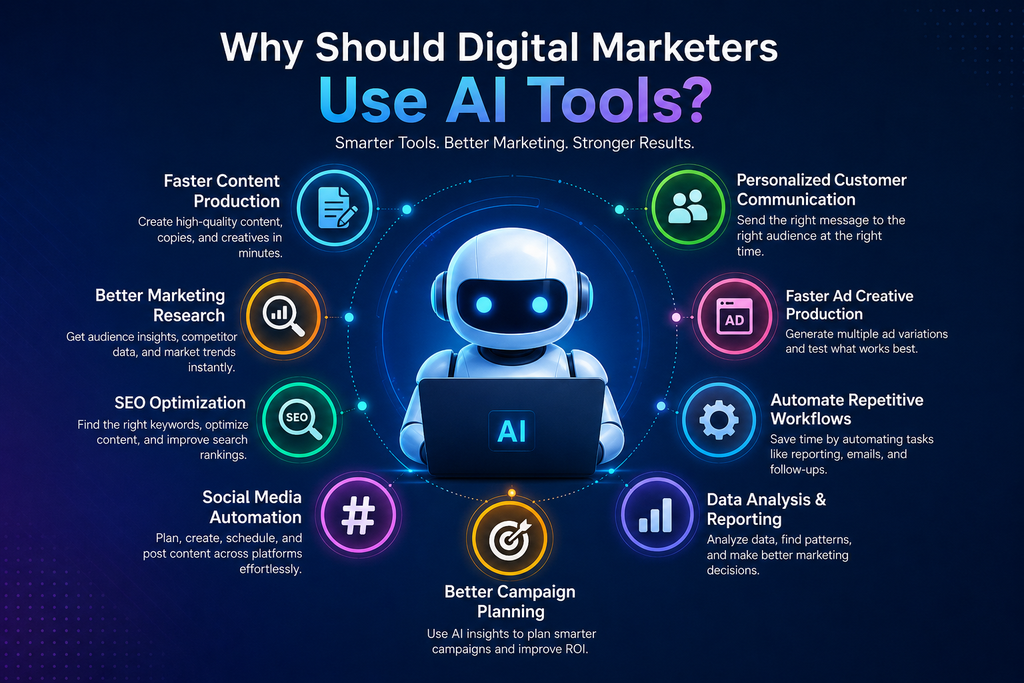
Traditional digital marketing often involves repetitive tasks such as keyword research, writing social media captions, creating ad variations, analysing reports, editing videos, and preparing email campaigns.
AI can reduce the time required for many of these tasks and allow marketers to focus more on strategy, creativity, customer understanding, and decision-making.
Modern AI marketing tools now cover everything from content and design to SEO, advertising, automation, analytics, and customer engagement.
Key benefits include:
- Faster content production
- Better marketing research
- SEO optimization
- Social media automation
- Personalized customer communication
- Faster ad creative production
- Automated repetitive workflows
- Data analysis and reporting
- Better campaign planning
- Increased marketing productivity
However, AI should be treated as a marketing assistant—not a complete replacement for human strategy and judgment.
25 Best AI Tools for Digital Marketers
1. ChatGPT — Best Overall AI Marketing Assistant
OpenAI’s ChatGPT is one of the most versatile AI tools available to marketers.
You can use it for:
- Blog ideas and outlines
- Social media captions
- Ad copy
- Email campaigns
- Marketing strategies
- Customer personas
- Competitor research
- Content repurposing
- Data analysis
- Brainstorming
For marketers who want one flexible AI assistant for multiple tasks, ChatGPT is an excellent starting point. OpenAI specifically highlights marketing use cases such as campaign analysis, creative development, and working with marketing tools and customer context.
Best for: Content, strategy, research and brainstorming.
2. Claude — Best for Long-Form Content
Claude is particularly useful when marketers need to work with large amounts of information.
It can help with:
- Long-form articles
- Marketing strategy documents
- Content editing
- Research summaries
- Brand messaging
- Campaign planning
Best for: Long-form writing and document-heavy marketing work.
3. Gemini — Best for Google Ecosystem Users
Google Gemini can be useful for marketers who already work heavily with Google’s ecosystem.
It can assist with:
- Content creation
- Brainstorming
- Research
- Campaign ideas
- Marketing emails
- Data interpretation
- Google Workspace-related tasks
Best for: Marketers working extensively with Google products.
4. Jasper — Best for Marketing Content at Scale
Jasper is designed specifically around marketing content creation.
It can help create:
- Blog posts
- Advertising copy
- Email campaigns
- Social media content
- Product descriptions
- Campaign messaging
Its focus on brand voice and marketing workflows makes it particularly useful for marketing teams and agencies managing content at scale.
Best for: Professional content teams and agencies.
5. Copy.ai — Best for Marketing Copy
Copy.ai focuses heavily on marketing and sales content.
Marketers can use it for:
- Ad copy
- Sales emails
- Social posts
- Product descriptions
- Website copy
- Campaign messaging
Best for: Short-form marketing copy and sales content.
AI Tools for SEO
6. Semrush — Best for SEO Research
Semrush is one of the most comprehensive SEO platforms for digital marketers.
It can help with:
- Keyword research
- Competitor analysis
- Website audits
- Backlink research
- Content planning
- Search visibility
- SEO reporting
Its AI capabilities can complement its broader SEO and competitive-intelligence features.
Best for: SEO professionals, agencies and businesses.
7. Surfer SEO — Best for Content Optimization
Surfer SEO focuses on optimizing content for search engines.
It can help marketers understand:
- Relevant keywords
- Content structure
- Search intent
- On-page optimization
- Content competitiveness
Its Content Editor provides real-time optimization guidance while writing.
Best for: SEO-focused content writers.
8. Frase — Best for SEO Content Briefs
Frase combines AI writing capabilities with SEO research.
It can help you:
- Research search results
- Create content briefs
- Identify relevant topics
- Optimize articles
- Generate content ideas
Best for: Bloggers and SEO content teams.
9. Clearscope — Best for Enterprise Content Optimization
Clearscope helps marketers create and optimize content around search intent and relevant topics.
It is especially useful for teams that publish large amounts of SEO content and need a consistent optimization process.
Best for: Enterprise SEO and content teams.
AI Tools for Design & Visual Content
10. Canva AI — Best for Social Media Design
Canva is one of the easiest options for marketers who need professional-looking visual content without advanced design skills.
You can create:
- Instagram posts
- YouTube thumbnails
- Presentations
- Ads
- Posters
- Infographics
- Marketing graphics
Canva’s AI capabilities make it easier to generate and adapt creative assets quickly.
Best for: Social media managers and non-designers.
11. Adobe Firefly — Best for AI Creative Production
Adobe Firefly can help marketers generate and modify visual content using AI.
Potential applications include:
- Marketing graphics
- Concept images
- Creative variations
- Image editing
- Campaign visuals
Best for: Professional creative teams.
12. Midjourney — Best for Creative Image Generation
Midjourney is widely used for creating visually distinctive AI-generated images.
Marketers can use it for:
- Campaign concepts
- Creative inspiration
- Social media visuals
- Brand moodboards
- Advertising concepts
Best for: Creative campaigns and visual experimentation.
AI Tools for Social Media Marketing
13. Buffer — Best for Social Media Management
Buffer helps marketers manage and schedule social media content.
AI features can assist with:
- Post ideas
- Captions
- Content repurposing
- Social media scheduling
Best for: Small businesses and social media managers.
14. Hootsuite — Best for Social Media Teams
Hootsuite combines social media management with AI-assisted features.
It can help marketers manage multiple social platforms and streamline content planning and publishing.
Best for: Businesses managing multiple social accounts.
15. Metricool — Best for Social Media Analytics
Metricool is useful for marketers who want to combine social media management with analytics.
You can use it to monitor:
- Social media performance
- Engagement
- Content performance
- Audience metrics
- Campaign results
Best for: Social media analytics and reporting.
AI Tools for Advertising
16. AdCreative.ai — Best for Ad Creatives
AdCreative.ai is designed specifically for creating advertising creatives.
It can generate variations for:
- Display ads
- Social ads
- Promotional campaigns
- Marketing banners
AI-powered creative tools can be particularly useful when marketers need many variations for testing.
Best for: Paid advertising and creative testing.
17. Google Ads AI — Best for Google Advertising
Google’s AI-powered advertising features can help marketers with campaign optimization, targeting, bidding and creative workflows.
Google’s Performance Max, for example, uses automation across Google’s advertising inventory.
Best for: Google Ads campaigns.
18. Meta Advantage+ — Best for Meta Advertising
Meta’s Advantage+ tools use AI and automation across areas such as audience targeting, creative optimization and campaign management.
This can help marketers simplify campaign optimization on Facebook and Instagram.
Best for: Facebook and Instagram advertising.
AI Tools for Email Marketing & CRM
19. HubSpot — Best for All-in-One Marketing
HubSpot combines CRM, marketing automation, analytics and AI capabilities.
Marketers can use it for:
- Lead generation
- Email marketing
- Customer segmentation
- Marketing automation
- Campaign management
- Personalization
- Reporting
HubSpot’s current marketing platform also includes AI capabilities for campaign creation, personalization and identifying high-intent leads.
Best for: Businesses looking for an integrated marketing platform.
20. Klaviyo — Best for E-commerce Email Marketing
Klaviyo is particularly popular with e-commerce brands.
AI can support:
- Email campaigns
- Customer segmentation
- Personalization
- Product recommendations
- Lifecycle marketing
Best for: E-commerce and DTC brands.
AI Tools for Video & Content Repurposing
21. Descript — Best for Video Editing
Descript allows marketers to edit video through a text-based workflow.
It can help with:
- Video editing
- Transcription
- Captions
- Podcast editing
- Content repurposing
Best for: Video marketers and content creators.
22. OpusClip — Best for Short-Form Video
OpusClip helps transform longer videos into shorter social media clips.
For example, one long YouTube video can potentially become multiple:
- YouTube Shorts
- Instagram Reels
- TikTok videos
- LinkedIn clips
AI-assisted clipping can significantly speed up the content repurposing process.
Best for: YouTubers and social media marketers.
AI Tools for Research & Automation
23. Perplexity — Best for AI-Powered Research
Perplexity is useful when marketers need to research topics and find source-backed information.
It can help with:
- Market research
- Competitor research
- Industry research
- Content research
- Fact discovery
Best for: Research-heavy marketing tasks.
24. Zapier AI — Best for Marketing Automation
Zapier can connect different marketing applications and automate repetitive workflows.
For example:
Website form → CRM → Email → Slack notification → Spreadsheet
Instead of manually moving information between applications, marketers can automate the workflow.
AI features can make these workflows more flexible and easier to build.
Best for: Marketing automation and productivity.
25. Gamma — Best for AI Presentations
Gamma helps marketers create presentations and other visual documents using AI.
It can be useful for:
- Client presentations
- Marketing proposals
- Campaign reports
- Sales presentations
- Pitch decks
- Internal presentations
Best for: Agencies, consultants and marketing teams.
Quick Comparison: 25 AI Tools for Digital Marketers
| # | AI Tool | Best For |
|---|---|---|
| 1 | ChatGPT | Overall marketing |
| 2 | Claude | Long-form content |
| 3 | Gemini | Google ecosystem |
| 4 | Jasper | Marketing content |
| 5 | Copy.ai | Marketing copy |
| 6 | Semrush | SEO |
| 7 | Surfer SEO | Content optimization |
| 8 | Frase | SEO content briefs |
| 9 | Clearscope | Enterprise SEO |
| 10 | Canva AI | Social media design |
| 11 | Adobe Firefly | Creative production |
| 12 | Midjourney | AI images |
| 13 | Buffer | Social media management |
| 14 | Hootsuite | Social media teams |
| 15 | Metricool | Social analytics |
| 16 | AdCreative.ai | Ad creatives |
| 17 | Google Ads AI | Google advertising |
| 18 | Meta Advantage+ | Meta advertising |
| 19 | HubSpot | CRM & marketing automation |
| 20 | Klaviyo | E-commerce email |
| 21 | Descript | Video editing |
| 22 | OpusClip | Video repurposing |
| 23 | Perplexity | Research |
| 24 | Zapier AI | Workflow automation |
| 25 | Gamma | Presentations |
Which AI Tools Should You Start With?
You don’t need all 25 tools.
A better approach is to choose tools based on your marketing goals.
For Content Marketing
ChatGPT + Claude + Jasper
For SEO
Semrush + Surfer SEO + Frase
For Social Media
Canva AI + Buffer + Metricool
For Paid Advertising
Google Ads AI + Meta Advantage+ + AdCreative.ai
For E-commerce
Klaviyo + Canva AI + ChatGPT
For Video Marketing
Descript + OpusClip + Canva
For Marketing Automation
HubSpot + Zapier AI
For Research
Perplexity + ChatGPT
How to Build an AI Marketing Stack
Instead of subscribing to every new AI tool, start with your biggest marketing bottleneck.
A practical workflow could look like this:
Step 1: Research
Use Perplexity or ChatGPT to understand your audience and market.
Step 2: Strategy
Use ChatGPT or Claude to develop your campaign strategy.
Step 3: SEO
Use Semrush and Surfer SEO to identify opportunities and optimize content.
Step 4: Content Creation
Use ChatGPT, Claude or Jasper to create initial drafts.
Step 5: Visual Design
Use Canva AI or Adobe Firefly to create marketing creatives.
Step 6: Distribution
Use Buffer, Hootsuite or Metricool to manage social content.
Step 7: Advertising
Use Google Ads AI, Meta Advantage+ and AdCreative.ai for paid campaigns.
Step 8: Automation
Connect your tools using HubSpot or Zapier.
Step 9: Analytics
Measure traffic, engagement, leads and conversions—and use AI to help identify patterns.
This approach is more effective than simply collecting AI tools. Current marketing guidance increasingly emphasizes choosing tools according to the specific job they need to perform rather than trying to find one universal AI solution.
Final Thoughts
AI is changing digital marketing from a collection of manual tasks into a more automated, data-driven and scalable workflow.
The best marketers in 2026 won’t necessarily be those who use the most AI tools. They’ll be the ones who know how to combine AI with human creativity, strategy, brand understanding and critical thinking.
If you’re just getting started, don’t try all 25 tools at once. Start with a simple stack such as:
ChatGPT → Canva AI → Semrush → Buffer → Zapier
Then add specialized tools when your marketing workflow actually requires them.
The goal isn’t to replace the marketer with AI. The goal is to make the marketer faster, smarter and more effective.
Tool capabilities and pricing can change frequently, so verify current plans directly with each provider before purchasing.